Data blind spot
Physical precursors such as gas venting and swelling are not adequately captured as data, which limits after-the-fact analysis and learning.
LAB INNOVATEUS · E-CNTShield
An ultra-thin sensor made from 40nm-class CNT material attaches directly to the battery cell and reads physical precursors that can appear before electrical signals do. Hardware first, then monitoring SaaS, then a battery data platform.
Battery anomalies can appear as gas, swelling, temperature change or physical deformation before a voltage anomaly is observed. There is a window that a BMS built around electrical signals may not see.
Gas, pressure and micro-deformation can appear at the cell first.
What E-CNTShield addsThe cell expands and structural stress builds. Hard to catch visually or electrically.
What E-CNTShield addsVoltage and current anomalies become observable — the primary window for most BMS.
What a conventional BMS mainly observesThe window that can lead to thermal runaway. This is post-incident territory.
What a conventional BMS mainly observesPhysical precursors such as gas venting and swelling are not adequately captured as data, which limits after-the-fact analysis and learning.
A gap opens between when the physical event occurs and when an electrical signal registers it.
Without precursor data there is no basis for a decision, so response slides to after the fact.
Eight steps, from material to cell attachment, multi-parameter sensing and early-signal monitoring.
The unit of monitoring is the cell, not the pack. Pack averages hide individual cell anomalies.
Carbon nanotubes and graphene — carbon atoms bonded in a hexagonal lattice, with high strength and electrical and thermal conductivity.
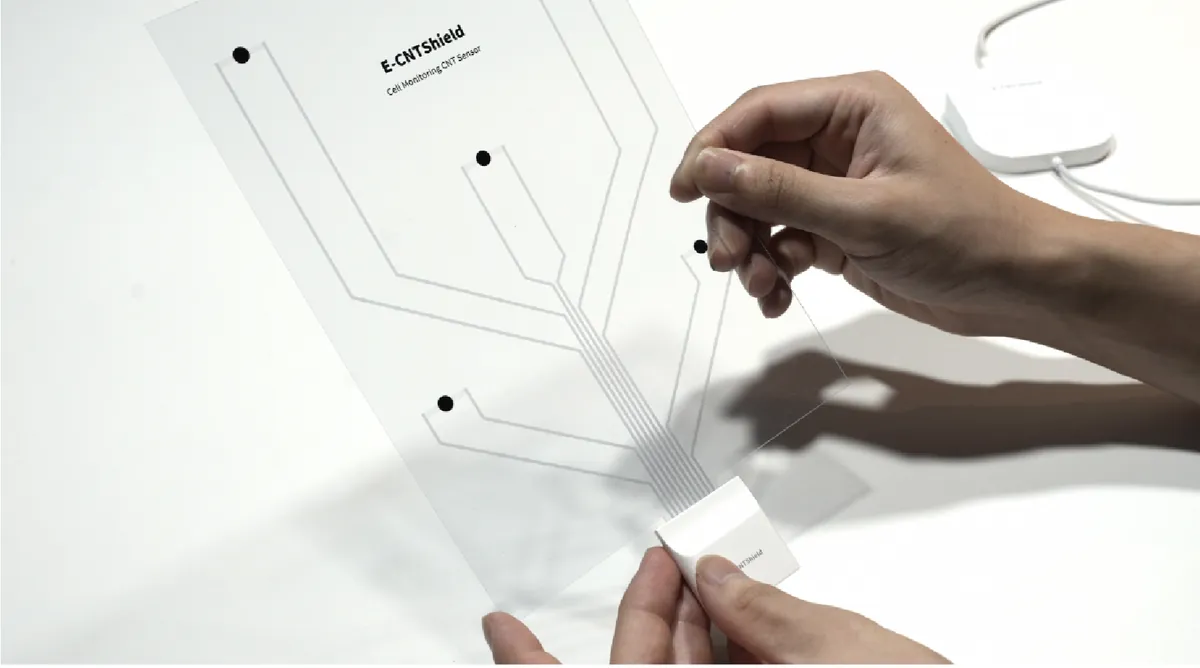
40nm-class CNT material is formed into an ultra-thin, flexible sensor sheet that adds little weight or volume to the cell.
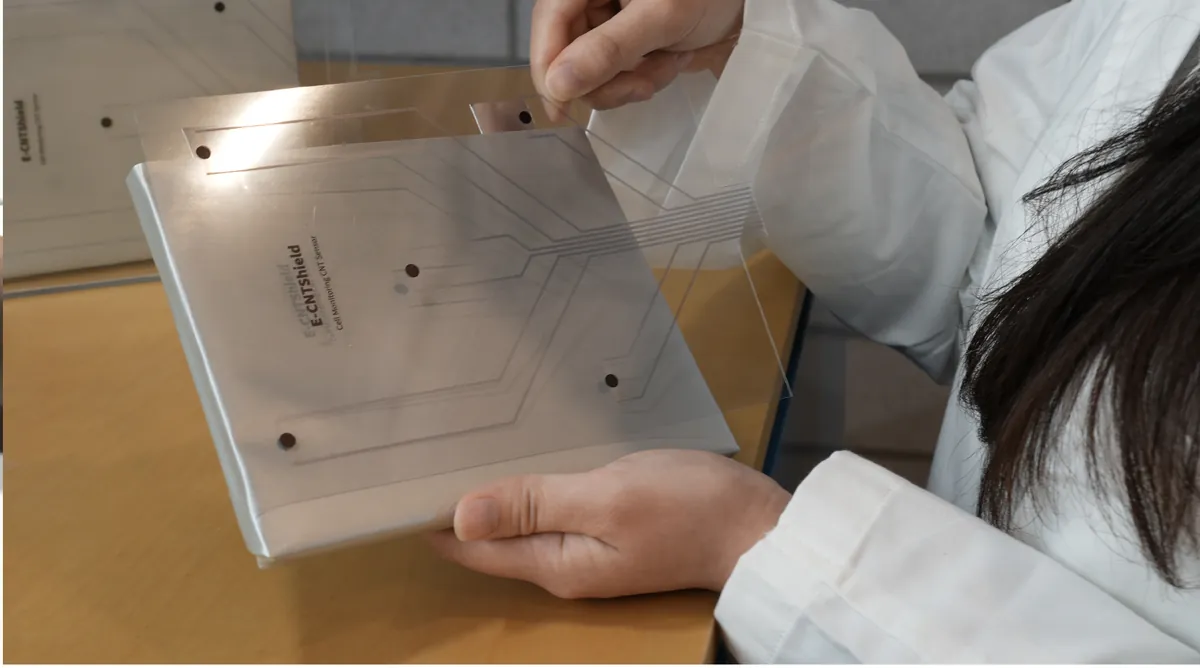
Applied directly to the cell surface. The flexible form follows the cell geometry.
Micro-scale physical distortion from external impact is read in the same layer.
Fine temperature change is tracked at the surface of each individual cell.
Swelling — the cell expanding as it degrades — is detected as a change in form.
Physical signals are combined and monitored as early indicators. We do not publish unverified detection times.
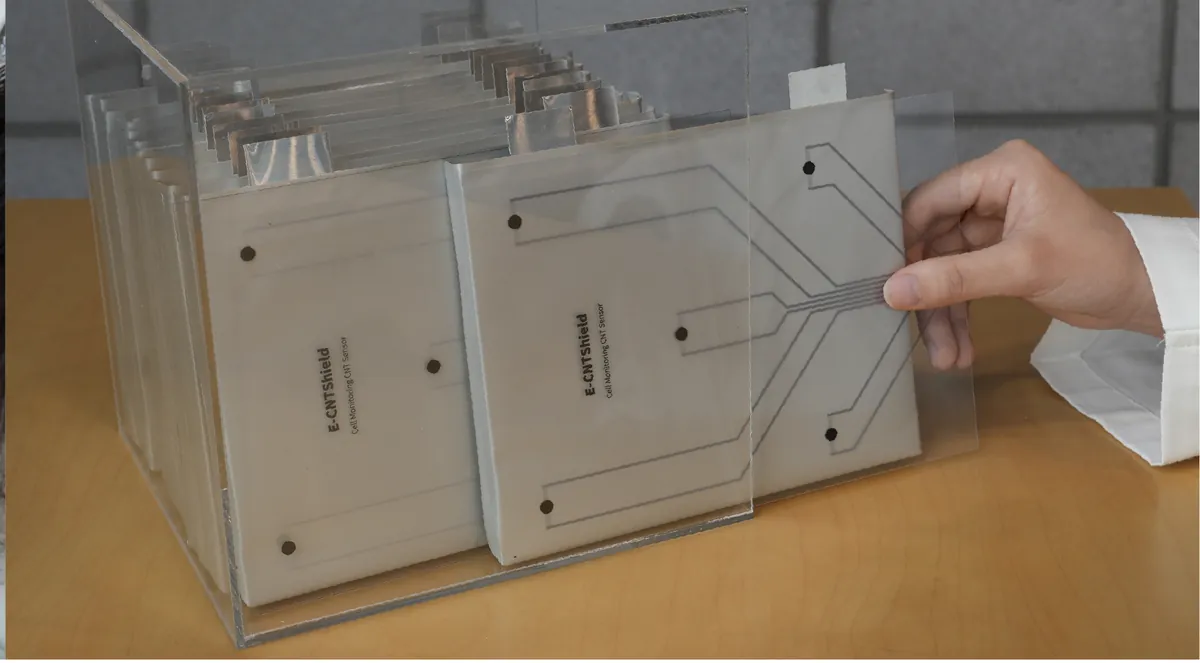
E-CNTShield is a printed sensor sheet. In the lab it is attached to battery cell surfaces, placed between cells in a module and read out as a resistance map.
Technology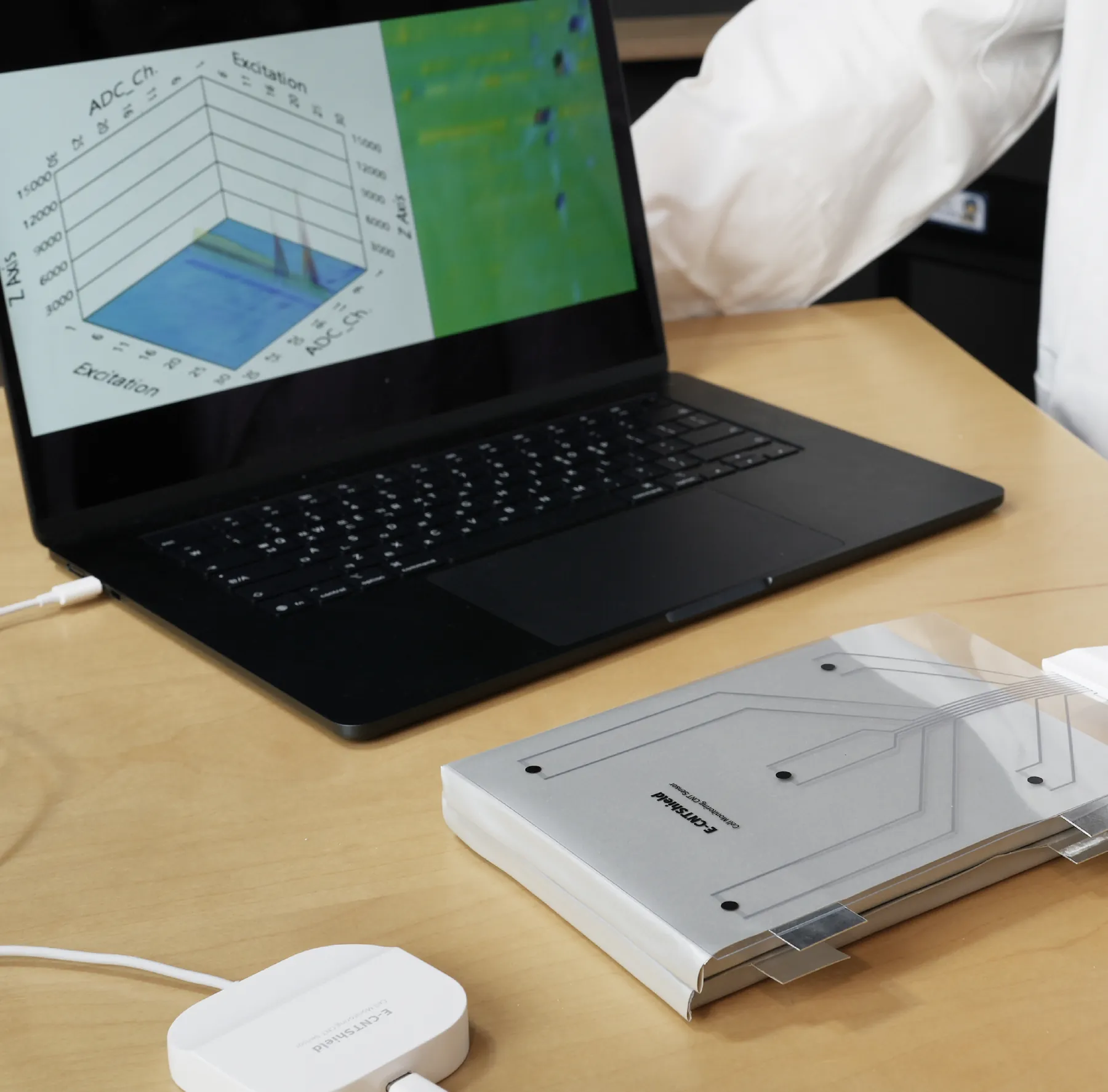
We start with stationary ESS and data centers, then expand to battery logistics and high-density battery applications.
Stationary energy storage, where battery safety management matters. Existing installations can be retrofitted.
UPS battery rooms, where many cells sit in one place and the facility cannot go down, so condition has to be watched continuously.
Tracking cell condition through storage and transport, where custody changes hands repeatedly.
Cell packs under continuous vibration and impact, where pack averages mask individual cell anomalies.
High-density batteries in tight, constantly moving modules, where sensing has to be miniaturized.
Adds cell-level pressure, temperature and swelling to operational data.

A CNT materials specialist with over ten years in battery sensor R&D, working across carbon-based composites, smart skin sensors, battery safety management and structural health monitoring.
Research team · 7
LAB INNOVATEUS, Hanyang University ERICA
Postdoctoral Researcher
Puneet Sagar
Postdoctoral Researcher
Sangeen Khan
Ph.D. Candidate
Yu-Jin Jung
Ph.D. Candidate
Ga-Hyeon Eom
Ph.D. Candidate
Liu Lichao
Undergraduate Research Assistant
Do-Hyun Kim
Lab Administrator
Julia Song
The questions that come up before meetings. We do not publish unverified performance figures.
For sensor module supply, field PoC, joint research and investment inquiries, please email us.